Charm Foundation has three flagship programmes designed for rural Bangladesh, each running 24 months. All three are fully costed proposals seeking funding rather than completed work, and we publish their targets so anyone can hold us to them.
Light of Learning: education and skills
Many children complete primary school without reading fluently or handling basic mathematics, and many drop out before finishing secondary education. Young people leave school without the skills employers ask for.
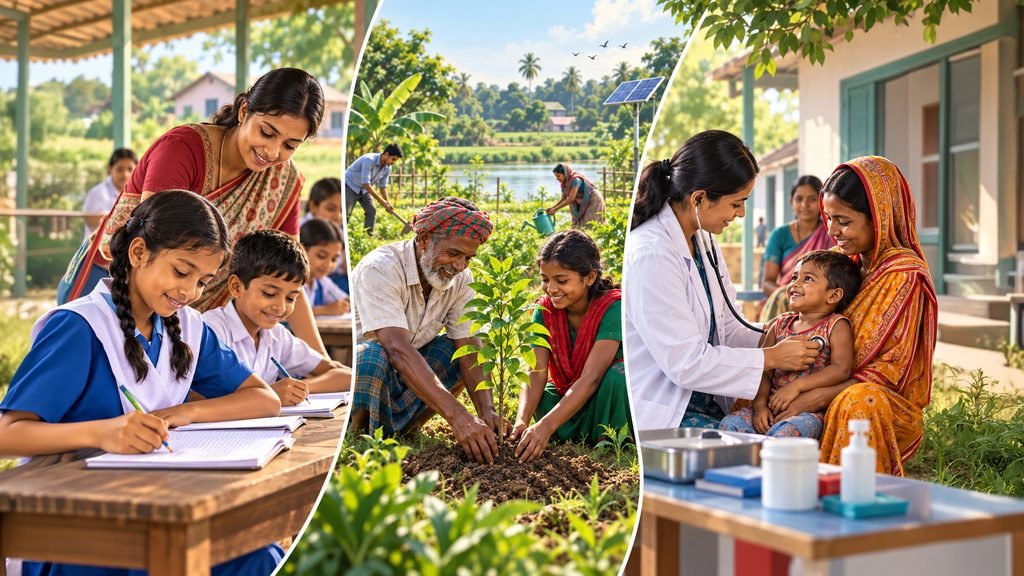
Light of Learning will run 40 community learning centres for 1,200 primary school children, at least half of them girls, with daily two-hour sessions six days a week. It will train 60 primary teachers, support 20 school management committees, run door-to-door re-enrolment drives and establish 40 adolescent clubs addressing child marriage and child labour. Four community digital labs will deliver a three-month course to 400 adolescents. Three hundred young people aged 15 to 24 will receive three to six months of certified training in market-relevant trades, followed by job fairs, apprenticeships, start-up kits for 120 of them and six months of mentoring.
The targets we will be measured against: at least 70 per cent of supported children reaching grade-appropriate reading and numeracy, a 30 per cent reduction in dropout among targeted children, and 60 per cent of trained youth in a job or self-employment six months after training. Proposed budget: BDT 18,500,000, approximately USD 151,600.
Green Village: climate resilience and environment
Rural households face floods, drought, heatwaves, riverbank erosion, salinity and unpredictable rainfall. Tree cover is falling and farmers are losing crops and income.
Green Village will plant and care for 50,000 native, fruit and timber saplings through five community nurseries run by women’s groups, with 60 tree-care teams and quarterly survival monitoring. Forty farmer field schools, run with the Department of Agricultural Extension, will support 1,000 farmers, at least 40 per cent of them women, with stress-tolerant seed, vermicompost and homestead vegetable production, plus small livestock packages for 200 landless households. Twenty villages will complete community risk mapping and preparedness plans approved by the union disaster management committee, with 100 trained early-warning volunteers and annual drills. On the household side: rainwater harvesting for 200 families and 10 schools, repair or raising of 20 water points, solar home lights for 200 poor families and improved cookstoves for 400.
Direct beneficiaries: 1,500 climate-vulnerable households, around 6,750 people, plus 20 schools reaching roughly 6,000 students. Target outcomes include at least 70 per cent sapling survival at month 24 and a 25 per cent average increase in yield or income among trained farmers. Proposed budget: BDT 16,000,000, approximately USD 131,100.
Healthy Family: health, nutrition, WASH and livelihoods
Remote villages are far from health facilities. Sanitation is inadequate, malnutrition persists, non-communicable diseases are rising, and low income keeps families from seeking care until it is expensive.
Working in close partnership with community clinics and the upazila health complex, Healthy Family will recruit and train 40 community health volunteers, most of them women, for monthly household visits and referral follow-up. It will run 48 health camps with qualified doctors covering general, eye, dental and maternal health, and screen 3,000 adults for hypertension and diabetes. It will deliver courtyard sessions for pregnant and lactating women, growth monitoring for children under five, menstrual hygiene sessions and kits for 600 adolescent girls, latrine support for the 300 poorest households, and handwashing facilities at 20 schools and 200 homes. Twenty women’s savings and enterprise groups will strengthen household income.
Direct beneficiaries: 2,000 poor households, around 9,000 people, including 800 pregnant and lactating women, 600 adolescent girls, 500 older people and 300 women in savings groups. Proposed budget: BDT 15,000,000, approximately USD 122,950.
What the three have in common
Each programme is implemented directly by Charm Foundation with community participation, overseen by a quarterly project advisory committee of government officers, head teachers, union parishad representatives and parents. Each has a baseline, a logical framework with numbered targets, a midterm review, an endline evaluation and a published budget. Project locations are being finalised; work outside Dhaka district requires prior approval of a working area extension from the Department of Social Services.
If your organisation funds education, climate resilience or community health in Bangladesh, the full proposals are available on request at info.sunriseruby@gmail.com