Charm Foundation is a non-profit, non-political voluntary social welfare organisation working with rural communities in Bangladesh. This post sets out plainly who we are, what we are registered to do, the three areas we work in, and the standards we hold ourselves to.
Our legal status
Charm Foundation is registered as a voluntary social welfare agency under Section 4(3) of the Voluntary Social Welfare Agencies (Registration and Control) Ordinance, 1961, by the Department of Social Services under the Ministry of Social Welfare. Our registration number is ঢ-০৯০২৭০, dated 15 September 2026, with certificate serial number ০০৮৮৫৫৬. The registering authority is the District Social Services Office, Dhaka. Our registered office is at House 27/A, Road 32, Gulshan, Dhaka.
Our approved area of operation is currently Dhaka district. Before implementing a project in any other district, we will apply to the Department of Social Services for an extension of our approved working area. We state this openly because communities and donors are entitled to know exactly what an organisation is, and is not, permitted to do.
Our vision
A rural Bangladesh where every child learns, every young person has a skill, every community lives in a healthy environment, and every family can reach quality basic healthcare.
Our mission
Charm Foundation works hand in hand with rural communities through accountable, inclusive and community-led programmes to improve children’s education and young people’s skills, protect the environment and strengthen climate resilience, and improve health and livelihoods.
Three areas of work
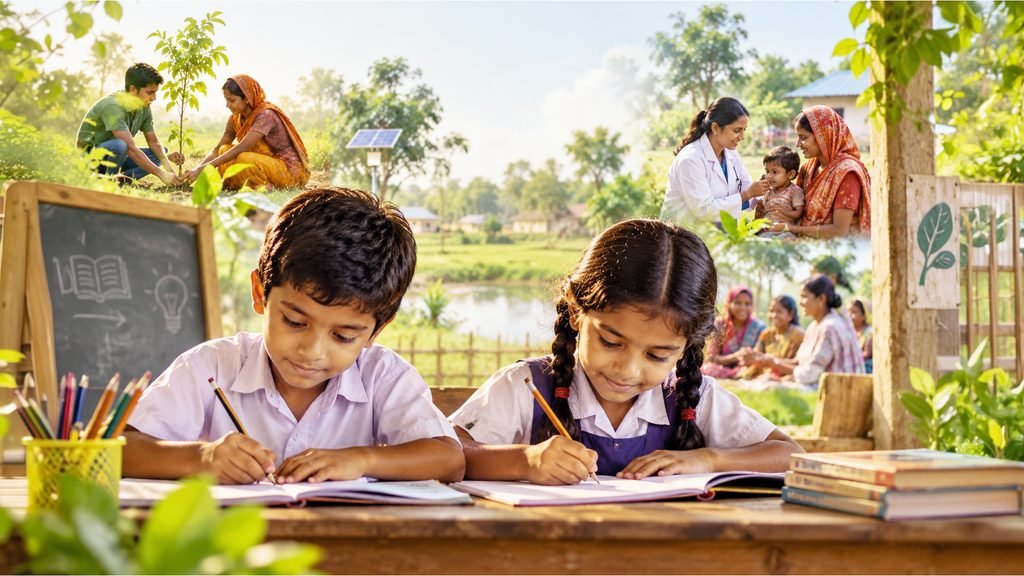
• Child education and skills development. Learning support for primary school children, keeping at-risk children in school, digital literacy for adolescents, and vocational training linked to real jobs for young people aged 15 to 24.
• Climate and environment. Community and school tree planting, climate-resilient agriculture, safe water and rainwater harvesting, disaster preparedness, clean cooking and solar lighting, and waste reduction.
• Healthcare and rural development. Free health camps and screening, maternal and child health, nutrition, menstrual hygiene management, WASH facilities, and savings and enterprise groups for poor households.
Across all three, our work is designed to contribute to the Sustainable Development Goals, particularly SDG 3 on good health, SDG 4 on quality education, SDG 5 on gender equality, SDG 6 on clean water and sanitation, SDG 8 on decent work and SDG 13 on climate action.
The values we hold ourselves to
• Integrity. We are honest in what we say, in our accounts and in our reporting. We have zero tolerance for fraud and corruption.
• Children first. A child’s safety and wellbeing come before any project target or deadline.
• Accountability. We answer to the communities we serve, to our donors and to the government, and we publish what we do.
• Inclusion. We reach the poorest first, along with girls and women, persons with disabilities and marginalised groups.
• Community ownership. Communities take part in planning, implementing and monitoring our work, so results last after a project ends.
• Respect for nature. We protect land, water, trees and biodiversity, and reduce our own environmental footprint.
• Learning. We measure results, learn from mistakes and improve.
How we work
Our approach is community-led: village committees, parents, young people and local leaders take part at every stage. It is integrated, because education, environment and health are connected, and a healthy, climate-resilient family is far more likely to keep its children in school. It is built on partnership with union parishads, upazila offices, schools, community clinics and other NGOs. It is evidence-based, with a baseline, indicators and a final evaluation on every project. And it is deliberately lean: we keep administrative costs low and our management systems strong.
Where we are going next
Our current registration is with the Department of Social Services. The next step is registration with the NGO Affairs Bureau, which is what allows an organisation in Bangladesh to receive and use foreign funding. Alongside that we have a project pipeline for 2027 to 2029 and a five-year strategic plan for 2027 to 2031. We are building the governance, financial and safeguarding systems that international donors require before that funding arrives, not after.
To work with us, support a project or ask a question, contact us at +880 1716-237917 & info.sunriseruby@gmail.com