Deciding who receives support is the most consequential decision a social welfare organisation makes, and the easiest one to get wrong. This post explains exactly how Charm Foundation selects beneficiaries, how we protect the people we work with, and how anyone can complain when we fall short.
Who we prioritise
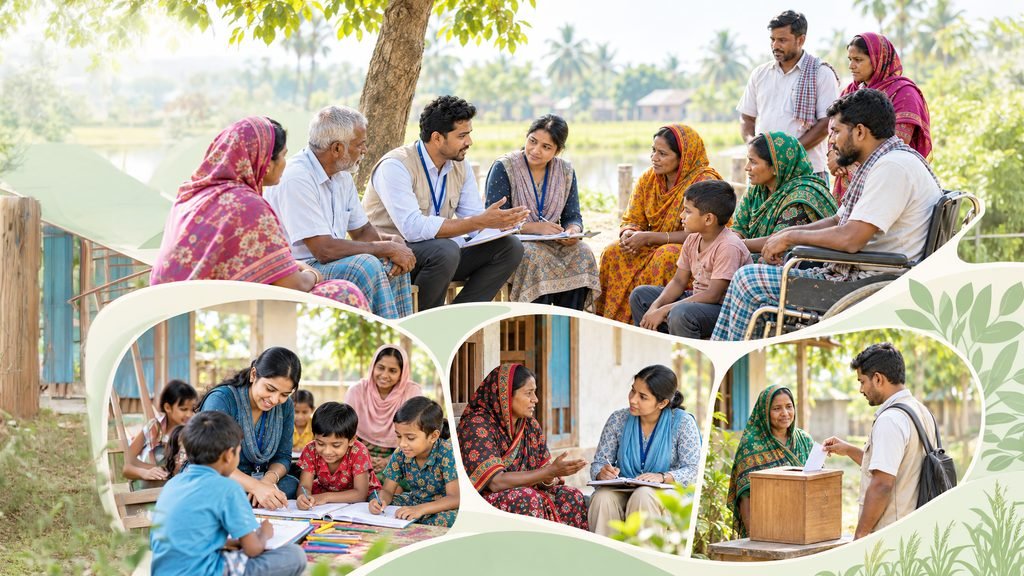
We work primarily in rural Bangladesh and give priority to households that are poor, climate-vulnerable or socially excluded. Our beneficiary groups include primary school children aged 6 to 11, adolescents aged 10 to 19 and especially adolescent girls, out-of-school and working children, unemployed young people, pregnant and lactating mothers, female-headed and poor households, small and landless farmers, climate-affected families, persons with disabilities and older people. Schools, school management committees, community groups and local government are partners in the same work.
The selection criteria
A household qualifies through four steps rather than one person’s judgement:
1. Location. The household must live in a union or village targeted by the project.
2. Vulnerability. It must meet at least two of these: household income below the local poverty line; landless or near-landless; female-headed; a household member with a disability; affected by disaster in the past three years; a child at risk of dropping out or of child labour.
3. No duplication. The household must not be receiving the same support from another organisation. We verify this.
4. Community verification. A community committee checks the selection, staff re-verify it, and the list is displayed publicly for objections before it is finalised.
The fourth step matters most. A list that is posted where neighbours can read it is a list that can be challenged, and a list that can be challenged is far harder to distort.
Safeguarding comes before targets
One of our stated values is that a child’s safety and wellbeing come before any project target or deadline. In practice that means safe recruitment procedures, a code of conduct, a two-adult rule, and a reporting system, with every staff member, tutor and volunteer trained in child safeguarding before they begin working with children. We maintain a child safeguarding and PSEAH policy and a named safeguarding focal person.
How to complain
Every project runs a complaints hotline, suggestion boxes and quarterly community feedback meetings, governed by our complaints and feedback response mechanism policy. Complaints can be made about staff conduct, selection decisions, service quality or anything else. We also maintain a whistleblowing policy so that staff and volunteers can raise concerns without fear of retaliation. A complaints system nobody knows about is not a complaints system, which is why the contact details are posted at every project site: + 09644-203040
How we measure results
Each project follows the same monitoring cycle: a baseline in the first two months, monthly activity monitoring, quarterly assessment, a midterm review at month 12, and an endline evaluation with a tracer study in months 23 and 24. Data is analysed separately by sex, age and disability, because an average figure can hide the exclusion of exactly the groups we set out to reach.
Our targets are published as numbers with verification sources attached — school records, attendance registers, training certificates, employer letters, living tree counts with GPS-tagged photographs, water tests. If we miss a target, the evidence will show it.
Money and governance
Charm Foundation is governed by an executive committee elected by the general assembly under our constitution approved by the Department of Social Services. Our financial year runs from 1 July to 30 June and our accounts are audited by a chartered accountancy firm. We operate under written financial management, procurement and human resources manuals, an anti-fraud and anti-corruption policy, a conflict of interest policy, a gender equality and social inclusion policy, and environmental and social safeguards. We keep administrative costs deliberately low.
These are the systems donors ask about, but they exist first for the communities we work with. Ask us anything: +880 1716-237917 & info.sunriseruby@gmail.com